Any driller who has worked the lands north of Highway 7 knows the rhythm changes once you cross the Humber River basin. In Vaughan, stratified deposits left by the Ontario Ice Lobe create a mosaic of dense Halton Till overlying silty sands and weathered shale — a profile that makes the Standard Penetration Test more than a routine index; it becomes the primary language for interpreting bearing capacity. Our field crews mobilize CME-75 rigs with automatic trip hammers calibrated to NBCC energy ratios, executing SPT borings at 1.5-metre intervals through overburden before transitioning to HQ coring at refusal. The test pits program often precedes deeper drilling when shallow utilities or organic fills near the Oak Ridges Moraine complicate access, and the grain size analysis from split-spoon samples confirms whether that grey silty layer is actually a liquefiable sand or a stiff glacial diamict.
A single corrected N60 value in Vaughan's Halton Till can distinguish between a spread footing design and the need for a deep pile foundation.
Service characteristics in Vaughan
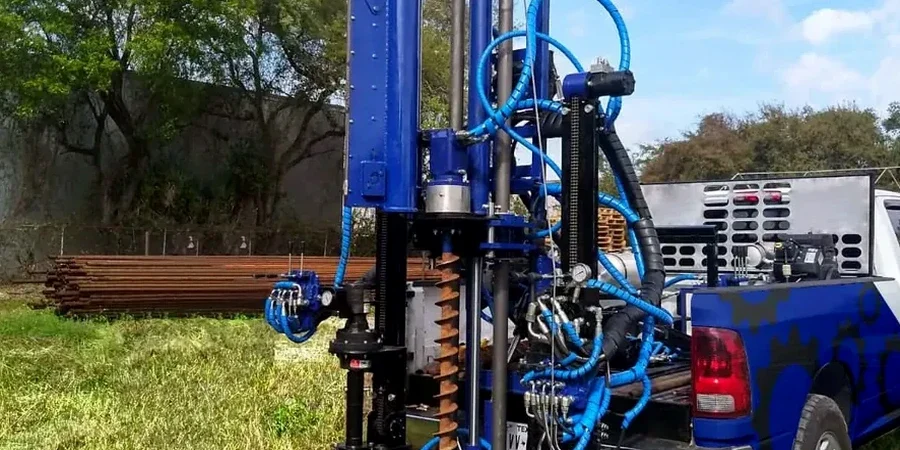
Local geotechnical conditions in Vaughan
A common oversight in Vaughan's development sector involves confusing auger refusal in dense till with bedrock contact — and stopping the boring there. The Oak Ridges Moraine contains erratic boulders and cemented lenses that produce refusal-like N-values exceeding 50 blows at depths where the regional bedrock (Georgian Bay Shale) still sits 8 to 12 metres below. Contractors who terminate borings at false refusal miss the compressible silty clay layers that often underlie these hardpans, creating settlement differentials that crack partition walls within the first freeze-thaw cycle. The specification must require coring through refusal zones to confirm lithology; otherwise, the SPT dataset carries a systematic bias that no amount of laboratory testing can later correct. The Ontario Building Code requires sufficient borehole depth to capture all strata influencing foundation performance — a requirement that false refusal directly violates.
Our services
SPT drilling in Vaughan integrates with broader geotechnical investigation workflows. The following activities are typically mobilized in sequence or parallel to build a complete subsurface model for foundation engineering.
SPT Drilling & Borehole Logging
Standard penetration testing with automatic hammer systems calibrated to NBCC energy ratios. Boreholes advanced through overburden with hollow-stem augers, continuous N-value recording, groundwater monitoring, and Shelby tube sampling in soft clay intervals.
N-Value Correction & Liquefaction Screening
Raw field N-values corrected to N60 and N1(60) using overburden pressure, hammer energy, and fines content adjustments. Liquefaction potential assessed per Seed & Idriss (1971) framework for Vaughan's seismicity zone.
Foundation Parameter Derivation
Translation of corrected SPT-N values into allowable bearing capacity, elastic settlement estimates, and pile skin friction parameters. Correlations validated against local knowledge in Halton Till and glaciofluvial deposits.
Top questions
What depth do SPT boreholes typically reach in Vaughan?
Borehole depth depends on the structure type and the site's geological setting within Vaughan's glacial terrain. For single-family homes and low-rise commercial buildings, borings typically extend 8 to 12 metres — through the Halton Till and into the underlying shale or competent lodgement till. Mid-rise structures near the Vaughan Metropolitan Centre often require 18 to 25 metres to capture potential soft layers above bedrock, while pile-supported towers may reach 30 metres or more. The Ontario Building Code requires boreholes to penetrate all strata that can influence foundation performance; we determine final depth in the field based on real-time penetration resistance and stratigraphic changes observed in the cuttings.
What does an SPT investigation cost in Vaughan?
A typical SPT investigation in Vaughan ranges from CA$660 to CA$1,090 per borehole, depending on depth, access constraints, and the number of sampling intervals required. Projects in tight urban sites near Highway 400 or with limited rig access may fall at the upper end due to traffic control and smaller track-mounted equipment. The estimate includes mobilization within the York Region, drilling, split-spoon sampling at 1.5-metre intervals, groundwater observation, borehole backfilling, and a signed engineering log with corrected N60 values. Laboratory testing of recovered samples — grain size analysis, Atterberg limits, or consolidation — is quoted separately based on the project scope.
How are SPT N-values corrected for energy and overburden in Ontario practice?
Field N-values are corrected in two steps per standard Ontario geotechnical practice. First, the raw blow count is normalized to a 60% hammer energy ratio: N60 = N × (ERi/60), where ERi is the measured energy ratio of the automatic trip hammer (typically 72–78% for CME-75 rigs). Second, the N60 is corrected for overburden pressure using the Liao & Whitman (1986) or Skempton (1986) CN factor: N1(60) = N60 × CN. Additional corrections for rod length, borehole diameter, and sampling liner are applied following ASTM D1586. The resulting N1(60) values feed directly into liquefaction triggering analyses and bearing capacity calculations in the NBCC framework.
How do you handle SPT refusal in Vaughan's dense glacial till?
SPT refusal — defined as 50 blows per 150 millimetres of penetration — is common in Vaughan's Halton Till and requires careful interpretation. When refusal occurs, the driller records the penetration achieved in millimetres for the 50 blows (for example, '50/75 mm'), which provides a quantitative refusal index. If refusal persists over a full 300-millimetre drive and bedrock is suspected, we switch to HQ-size coring with a diamond bit to recover continuous rock core for RQD determination. The critical step is distinguishing between a boulder or cemented till lens — which produces sudden, isolated refusal — and the actual top of the Georgian Bay Shale, which shows a gradual increase in resistance. Misidentifying a boulder as bedrock leads to boreholes that are too shallow and miss underlying compressible layers, creating a significant foundation risk.