The National Building Code of Canada (NBCC) and CSA A23.3 demand reliable shear strength parameters for any foundation or excavation design in Vaughan. We run triaxial tests on undisturbed Shelby tube samples and remolded specimens to deliver effective stress envelopes, total stress parameters, and pore pressure response. Vaughan sits on the South Slope of the Oak Ridges Moraine, where silt tills, clay plains, and occasional sand lenses create complex stratigraphy — a single set of generic strength values won’t cut it here. Our lab applies ASTM D4767 for consolidated-undrained (CU) conditions with pore pressure measurement, and ASTM D2850 for unconsolidated-undrained (UU) tests when time is tight. The result: design data that matches actual ground behavior under load, whether you’re working near Highway 400, the Vaughan Metropolitan Centre, or a residential subdivision in Woodbridge. We also cross-check results with index tests from grain size distribution when classifying borderline silts and clays.
Triaxial testing in Vaughan’s glacial tills and silty clays delivers phi’ and Su values that replace generic code tables with measured ground truth — every foundation design benefits from it.
Service characteristics in Vaughan
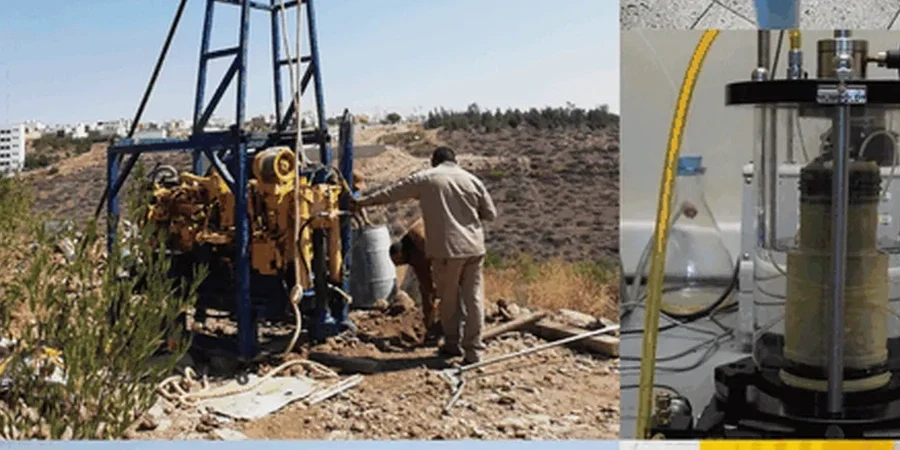
Local geotechnical conditions in Vaughan
Vaughan’s near-surface geology along the Oak Ridges Moraine includes interbedded silt, clay, and sand units with variable drainage conditions. Pore pressure behavior during shear — contractive or dilative — directly governs whether a saturated silt layer will lose strength rapidly under undrained loading. We’ve seen CU tests on silty samples from the Keele Valley area show peak deviator stress at 4 percent axial strain, followed by a 30 percent drop within the next 2 percent strain — a clear strain-softening pattern that conventional bearing capacity equations don’t capture. For slopes along the Humber River corridor, effective stress envelopes from CD triaxial tests become essential input for limit-equilibrium analysis. The difference between a phi’ of 28 and 32 degrees changes the computed factor of safety by 15 to 20 percent. When we run triaxial programs, we always report the stress path data — not just the Mohr-Coulomb envelope — because the path to failure tells you more about in-situ behavior than the envelope alone. For cohesionless materials where undisturbed sampling isn’t feasible, we combine triaxial data with CPT test correlations calibrated to local geology.
Our services
Our triaxial testing program covers the full range of loading conditions needed for foundation and earthwork design in the Vaughan area. Each test program starts with a review of the borehole logs and sampling quality — only undisturbed specimens with recovery ratios above 85 percent proceed to triaxial testing. We prepare specimens in a controlled humidity room, saturate using back-pressure methods, and consolidate to the estimated in-situ effective stress before shear.
CU Triaxial with Pore Pressure Measurement (ASTM D4767)
Consolidated-undrained testing with electronic pore pressure transducers. We determine effective stress parameters c' and phi' for drained analysis of slopes, retaining walls, and long-term foundation settlement. A minimum of three specimens per unit, consolidated to different isotropic stresses matching the in-situ stress range. Full saturation verification via B-value check. We deliver Mohr-Coulomb envelopes, stress-strain curves, and p-q diagrams suitable for import into geotechnical FEM software.
UU Triaxial for Short-Term Stability (ASTM D2850)
Unconsolidated-undrained testing for rapid assessment of undrained shear strength in fine-grained soils. Used during construction-stage analysis — open-cut excavations, shoring design, and temporary slope stability. Specimens are loaded at a strain rate of 1 percent per minute; failure is defined at maximum principal stress difference or 15 percent axial strain. Results offer the Su profile needed for total-stress analysis under short-term loading conditions.
Top questions
What does a triaxial test cost in Vaughan?
A standard triaxial program in Vaughan ranges from CA$2.300 to CA$3.770 depending on the number of specimens, confining stress levels, and whether CU or UU protocols are applied. A three-specimen CU program with pore pressure measurement sits at the upper end; a single UU test is at the lower end. We offer a detailed quote after reviewing the borehole logs and testing objectives.
How long does a triaxial test program take?
A CU triaxial program with three specimens typically requires 7 to 10 working days from sample preparation to final report. Consolidation stages can run 24 to 48 hours for low-permeability clays; shear stages add another 6 to 8 hours per specimen. UU tests are faster — usually 3 to 4 days for a set. We can expedite when project schedules demand it, without compromising saturation or consolidation protocols.
Which triaxial test type do I need for foundation design in Vaughan?
It depends on the loading scenario. For long-term drained conditions — spread footings, retaining walls, permanent slopes — you need CU testing with pore pressure measurement to obtain effective stress parameters c' and phi'. For short-term construction conditions — excavation stability, shoring design — UU testing provides the undrained shear strength Su for total-stress analysis. Most projects in Vaughan’s silty clay and till strata require both test types for a complete geotechnical model.
How do you ensure sample quality before triaxial testing?
We log every Shelby tube upon arrival: recovery ratio, visible disturbance, fissuring, and signs of swelling or desiccation. Specimens are trimmed in a humidity-controlled room and inspected for cracks, gravel inclusions, or bedding planes that could cause premature failure. Only specimens with a recovery ratio above 85 percent and no visible defects proceed to the triaxial cell. For borderline samples, we run index tests — Atterberg limits and grain size — to confirm the material classification before committing to a full triaxial program.