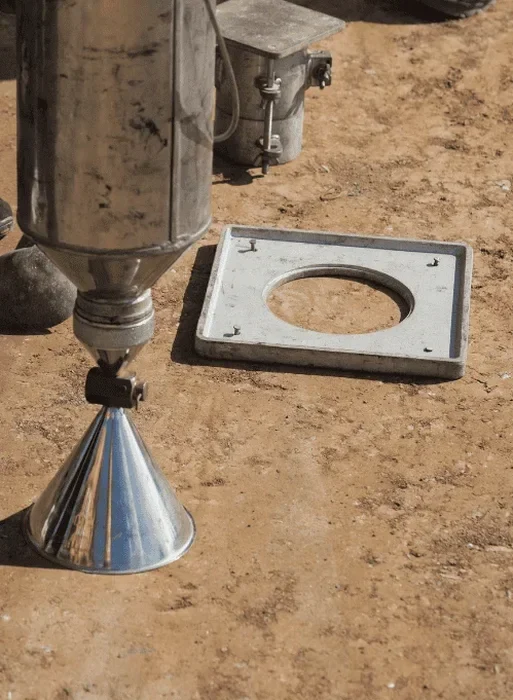
Meeting compaction specs in Vaughan isn't just about passing inspection—it's about the glacial till that runs under half the city. The Ontario Building Code references NBCC 2015, which ties foundation performance directly to engineered fill density. Our lab runs the sand cone method per ASTM D1556 because it gives you a direct, physical measurement of in-place density, no calibration curves or nuclear gauges needed. For the clay-rich Halton Till common north of Highway 7, we often pair field density with a grain size analysis to confirm the fines content isn't skewing the Proctor reference. And when the spec calls for deeper bearing verification, the plate load test provides modulus values right at the compaction lift surface.
You can't argue with a hole in the ground and a scale. The sand cone gives you a density number you can verify with nothing more than a calculator.
Service characteristics in Vaughan
Live process video
Local geotechnical conditions in Vaughan
The freeze-thaw cycles in Vaughan are brutal on poorly compacted fill. We see it every March—garage slabs heaved, asphalt driveways cracked, retaining walls leaning forward. The problem almost always traces back to density tests that were rushed or skipped during the November construction push, when the ground is already half frozen and the moisture content is impossible to control. In the west end near the Humber River floodplain, the water table sits high, and if your backfill isn't above 95% Standard Proctor, you're inviting settlement that will show up within two winters. The sand cone test gives you a number you can trust, but only if the technician digs the hole properly and the baseplate is seated tight on a level surface. On silty sites, we also run Atterberg limits to flag any plasticity that could turn a dense fill into a soft mess after a heavy rain.
Our services
Every compaction project in Vaughan needs a clear target density and a reliable way to measure it. Our field activities cover the full chain from lab Proctor to in-place verification.
Standard Proctor (ASTM D698)
Lab compaction test to establish the moisture-density relationship for silty and clayey soils typical of Vaughan subdivisions.
Modified Proctor (ASTM D1557)
Higher compactive effort for heavy-duty pavements and engineered structural fill under commercial footings.
Sand Cone Field Density
On-site density and moisture content verification using calibrated Ottawa sand per ASTM D1556.
Nuclear Gauge Correlation
When the project uses a nuclear gauge, we offer sand cone correlation tests to validate gauge readings against physical density.
Top questions
How much does a sand cone density test cost in Vaughan?
A single sand cone test in Vaughan typically runs between CA$150 and CA$220 per location, depending on travel distance within the GTA and the number of tests on the same day. Projects with multiple test locations benefit from reduced per-point pricing.
How many sand cone tests do I need for my driveway or garage pad?
For a standard residential driveway or garage pad in Vaughan, we generally recommend a minimum of one test per lift per 500 square feet. If the native soil is the silty Halton Till, we often suggest tighter spacing because moisture variability can create soft spots that a single test won't catch.
Can you do a sand cone test in the rain or on frozen ground?
Rain itself doesn't stop the test, but saturated soil makes it hard to dig a clean hole without smearing the sides, which throws off the volume measurement. Frozen ground is a hard no—the sand won't flow properly into the hole, and the density reading will be meaningless. We reschedule for dry weather and unfrozen conditions.