Specifying asphalt thickness without a verified California Bearing Ratio is a gamble that costs Vaughan contractors money. The clay-rich soils across the Humber River valley and the Oak Ridges Moraine can look firm at surface level but fail under load once the freeze-thaw cycle hits. A laboratory CBR test removes that uncertainty by measuring the actual bearing strength of compacted subgrade samples under controlled moisture conditions. We run ASTM D1883 soaked and unsoaked CBR tests on remolded specimens prepared to the density specified in the project’s geotechnical report. For sites near the Highway 400 corridor where granular borrow is scarce, the test often reveals whether native silty clay can be reused or needs replacement. This data feeds directly into the AASHTO 1993 pavement design method used by most Ontario municipalities. Pairing CBR results with a grain size analysis pinpoints exactly which fraction is causing low bearing values, and a field plate load test verifies that the compacted lift in place matches what the lab predicts.
A soaked CBR value below 3% in Vaughan’s glaciolacustrine silts typically means the subgrade needs chemical stabilization or a thicker granular base—ignoring it guarantees rutting within two winters.
Service characteristics in Vaughan
Local geotechnical conditions in Vaughan
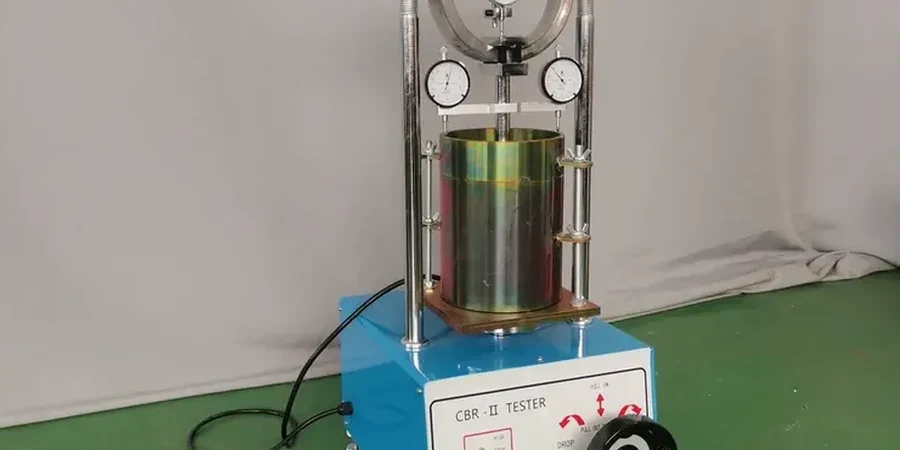
The loading frame used for CBR penetration in our Vaughan-bound projects is a motorized constant-rate machine with a 50 kN capacity ring-type load cell, calibrated quarterly to CSA A283 standards. The piston advances at exactly 1.27 mm per minute while a digital data logger captures load and displacement simultaneously. If the rate drifts even 5% from spec, ASTM D1883 requires the test to be discarded—penetration speed directly affects the load-penetration curve shape and inflates or deflates the reported CBR. For Vaughan’s silty subgrades, a more insidious risk is moisture loss during specimen transport from the field. A sample that dries out by 2% before compaction in the lab can show CBR values 40% higher than the true soaked condition, leading to under-designed pavement that ruts after the first spring thaw. Our field technicians seal samples in double plastic bags immediately after extraction and deliver them to the lab within six hours. The in-situ density testing by sand cone provides the field compaction reference that the CBR specimen must replicate—without it, the lab result has no anchor to actual site conditions.
Our services
Our Vaughan laboratory provides three tiers of CBR-related testing, each matching a different phase of pavement and earthworks projects across York Region.
Soaked CBR (96-Hour)
Full ASTM D1883 procedure with four-day submersion and swell monitoring. Used for final pavement thickness design on Vaughan arterial roads, commercial parking lots, and industrial yards where spring thaw saturation is the controlling condition.
Unsoaked CBR with Proctor
CBR penetration at optimum moisture content immediately after compaction. Provides a baseline bearing value for temporary construction platforms, crane pads, and access roads that will not knowledge long-term saturation.
CBR Correlation Package
Combines CBR with grain size distribution and Atterberg limits on the same soil sample. Used when the pavement consultant needs to justify granular borrow import or subgrade stabilization with lime or cement for Vaughan's low-strength silts.
Top questions
What does a laboratory CBR test cost in Vaughan?
A standard soaked CBR test on one remolded specimen typically ranges from CA$190 to CA$300, depending on whether standard or modified Proctor compaction is required and how many points the client needs on the moisture-density curve. Multi-point packages that include grain size and Atterberg limits usually fall between CA$400 and CA$600 per sample. Turnaround time is five to seven business days.
How is the CBR value used in Vaughan pavement design?
The soaked CBR at 2.54 mm penetration is entered into the AASHTO 1993 flexible pavement design equation or the Ontario Ministry of Transportation’s pavement design tables. It determines the required structural number and granular base thickness above the subgrade. For Vaughan’s typical silty clay subgrades with CBR between 2% and 5%, the structural section usually calls for 150 to 200 mm of hot-mix asphalt over 300 to 450 mm of Granular A and B.
How many CBR samples do I need for a commercial parking lot in Vaughan?
Ontario practice recommends one CBR sample per 1,000 to 2,000 square metres of subgrade, with a minimum of three samples per distinct soil unit. For a typical 5,000 m² commercial lot, this means three to five samples taken from different locations and depths. If the site straddles two different soil units—common where the Oak Ridges Moraine transitions to the Peel Plain—testing each unit separately is required.