Vaughan sits on a complex mix of Halton Till and glacial lake deposits — dense, silty clay that swells when wet and shrinks in summer drought. Retaining wall design here must account for high lateral earth pressure and variable groundwater perched above the clay aquitard. Most residential lots in Woodbridge and Maple were graded decades ago, but taller walls over 1.2 m trigger municipal review under the Ontario Building Code. We offer retaining wall design that integrates site-specific soil parameters, global stability checks, and structural detailing per CSA A23.3. Whether it is a gravity wall for a backyard terrace or a cantilever wall supporting a new driveway cut, we run bearing capacity and sliding checks before a single bucket hits the ground.
A well-designed retaining wall in Vaughan must handle more than earth — it must survive freeze-thaw cycles, clay swell, and surcharge from the neighbour’s pool.
Service characteristics in Vaughan
Local geotechnical conditions in Vaughan
Woodbridge properties along the Humber floodplain encounter soft organic silts at just 2 m depth — a wall founded there without a global stability check can rotate forward within the first wet season. Compare that to Thornhill Woods, where dense till provides competent bearing but groundwater perches on the clay and migrates laterally behind the wall. The most expensive repair we see is a wall pushed out of plumb by ice lensing, because the drainage stone was omitted or the weep holes clogged. In Vaughan, poor drainage is the number one cause of retaining wall failure, not inadequate steel. We design the subdrain system as carefully as the reinforcement cage, specifying clean 19 mm clear stone wrapped in non-woven geotextile.
Our services
Our retaining wall design in Vaughan covers everything from concept sketches for a permit application to full IFC packages for a builder. We focus on what the municipality reviews: structural stability, global slope safety, and positive drainage.
Residential Retaining Wall Design & Permit Drawings
Gravity walls, cantilever walls, and segmental block walls under 3 m. Includes soil investigation coordination, bearing capacity check, stem and footing reinforcement schedule, weep-hole layout, and a stamped General Review commitment letter for the City of Vaughan permit desk.
Commercial & Tall Wall Engineering (3 m+)
Cantilever, counterfort, and soldier pile walls with precast lagging. We run global slope stability on Slide2, design the subdrain network, and coordinate with the shoring designer when the wall also serves as a permanent basement wall. Full sealed package for site plan approval.
Top questions
What does retaining wall design cost in Vaughan?
Fees for a retaining wall design in Vaughan typically range from CA$1.490 for a simple gravity wall under 1.5 m with clear access to soil data, up to CA$5.620 for a tall cantilever or counterfort wall requiring global stability modeling, city pre-consultation, and multiple submission rounds. The final number depends on wall height, surcharge conditions, and whether we need to commission a borehole on your lot.
At what height does the City of Vaughan require a building permit for a retaining wall?
A building permit is required when the wall exceeds 1.2 m in height measured from the bottom of the footing to the top of the wall, or when it supports a surcharge such as a driveway, pool, or structure. Walls under 1.2 m still need to be structurally safe, and we often offer a sealed letter of opinion for the homeowner's peace of mind even when a full permit is not triggered.
How do you address groundwater behind the wall in Vaughan clay soils?
Vaughan's Halton Till has low permeability, but water perches in granular seams and in the backfill zone. We specify a continuous 150 mm clear stone chimney drain wrapped in non-woven geotextile, connected to a 100 mm perforated HDPE collector at the base, discharging to daylight or a sump. Weep holes at 2 m spacing are detailed as a redundant path — if the primary drain slows, the wall does not suddenly become a dam.
What is the difference between a gravity wall and a cantilever wall?
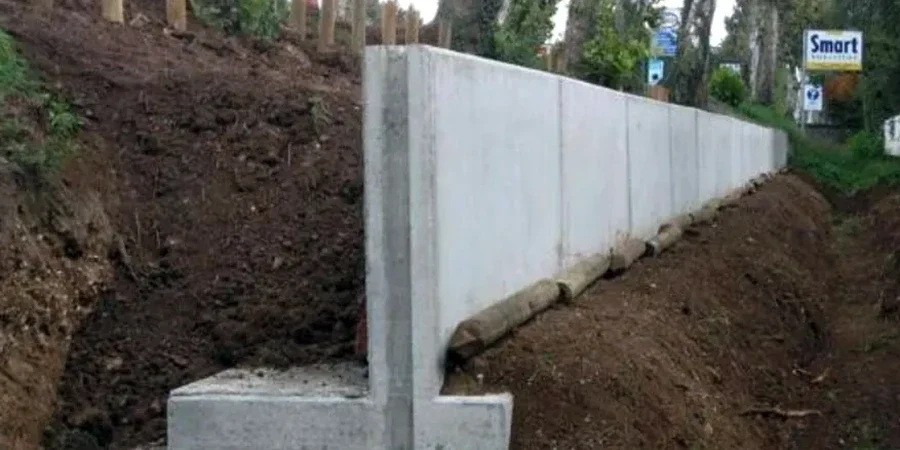
A gravity wall relies on its own mass — concrete, stone, or segmental block — to resist sliding and overturning. It works well up to about 2 m in Vaughan if you have room for a wide base. A cantilever wall uses a reinforced concrete stem and footing to engage the weight of the soil above the heel for stability. It uses less concrete than a gravity wall for heights over 1.8 m and fits tighter lot lines, which is why we specify it often in Woodbridge and Maple infill projects. More info.