With over 320,000 residents and a building boom that added nearly 15,000 new housing units in a recent five-year span, Vaughan’s subsurface conditions demand careful attention before any foundation is poured. The city sits on the South Slope of the Oak Ridges Moraine, where glacial till, sand lenses, and pockets of silty clay can shift dramatically within a single lot. An exploratory test pit is the most direct method to expose these layers, letting our technical team log stratigraphy, measure groundwater seepage, and extract undisturbed samples right at the depth where footings will bear. Because Vaughan enforces Ontario Building Code requirements tied to NBCC 2015, skipping this step can trigger costly redesigns once excavation reveals what the borehole alone missed. When access permits, we often pair the pit with a CPT sounding to cross-check density trends at depth, or run a resistance test on the exposed surface to confirm bearing assumptions before the concrete crew arrives.
An exploratory test pit turns a two-dimensional borehole log into a three-dimensional view of the soil fabric, revealing lenses and contacts that rotary drilling can miss.
Service characteristics in Vaughan
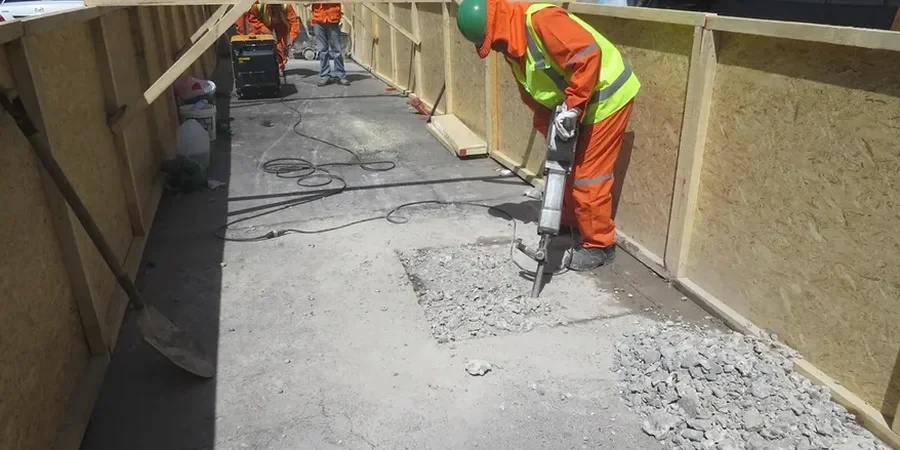
Local geotechnical conditions in Vaughan
The glacial stratigraphy beneath Vaughan includes the Halton Till overlying older sediments of the Thorncliffe Formation, and in many areas a weathered crust of stiff clay caps the profile—conditions that create a false sense of security during a desk study. An exploratory test pit that stops short of penetrating the weathered zone may report refusal on dense material that is only a thin veneer over much softer, compressible silt. In the Rutherford Road corridor, we’ve logged artesian seepage at less than three metres depth where the sand and gravel aquifer is confined by the till, a detail that changes dewatering plans and basement waterproofing specifications. The Ontario Occupational Health and Safety Act requires engineered shoring or benching for any pit deeper than 1.2 metres, and failure to comply exposes the owner to stop-work orders and liability. Relying solely on a drill rig without an exploratory test pit also risks missing buried organics, old foundations, or undocumented fill that can delay a project for weeks once the excavator bucket unearths them.
Our services
Our Vaughan-based team delivers exploratory test pit investigations integrated with laboratory testing and engineering recommendations, covering everything from single-family lots to large-scale industrial developments in the Highway 400 corridor.
Stratigraphic Test Pit Logging
Machine-excavated pits with manual trimming, logged by a geotechnical engineer or senior technician. Each stratum is described, photographed, and sampled for laboratory index testing. We offer a signed field log and a digital report with recommendations on bearing capacity and excavation conditions.
Combined Test Pit and In-Situ Testing
When the project requires both visual profiling and quantitative data, we run plate load tests directly on the pit floor, or carry out density testing and permeability measurements. This package is common for warehouse pads and townhouse blocks where pad footings must be verified across the entire footprint.
Top questions
How much does an exploratory test pit cost in Vaughan?
For a typical single pit up to 3.5 metres deep with logging, photography, and basic sampling, the cost ranges from CA$660 to CA$1,090 depending on access, spoil disposal, and whether a trench box is needed. Deeper pits, multiple locations, or additional in-situ tests such as plate load or density will increase the total.
What is the difference between a test pit and a borehole?
A borehole provides a continuous vertical core or disturbed sample from a small-diameter hole, while an exploratory test pit exposes a larger face of soil so the engineer can see layering, fractures, and inclusions directly. Test pits are limited to about four or five metres depth but give a far clearer picture of the near-surface conditions that affect shallow foundations.
Do I need a permit or locates before digging a test pit in Vaughan?
Yes. Ontario law requires a locate request through Ontario One Call at least five business days before any excavation. Depending on the site, the City of Vaughan may also require a site alteration or grading permit if the pit is part of larger earthworks. Our team handles the locate coordination as part of the mobilization.
Can you backfill the test pit after the investigation?
Yes, backfilling is included in our standard service. We compact the material in lifts per OPSS.MUNI 206 or the project specification, and if the pit was opened in a paved area we can arrange temporary cold-patch restoration. For structural fill requirements, we document density tests on the backfill as well.