Vaughan's rapid transformation from farmland to dense urban center above the Oak Ridges Moraine has created unique subsurface challenges. The city sits atop a complex sequence of glacial tills, interglacial sands, and the dense Halton Till, causing abrupt variations in bearing capacity across short distances. A soil mechanics study in Vaughan must account for these stratigraphic discontinuities, where a stiff clay layer might transition to loose saturated silt within 50 meters. The expansion of the Vaughan Metropolitan Centre and the Cortellucci Vaughan Hospital tested these ground conditions extensively. Before any excavation or foundation pour, understanding shear strength, consolidation potential, and the depth to competent till becomes the foundation of a safe structural design.
In Vaughan, average undrained shear strength in the Halton Till exceeds 150 kPa, yet a thin interbedded silt lens can reduce global stability by 40% if undetected.
Service characteristics in Vaughan
Live process video
Local geotechnical conditions in Vaughan
With a population exceeding 323,000 and a development map pushing north toward the protected Greenbelt, Vaughan faces pressure to build on marginal lands previously deemed unsuitable. The most significant risk in a soil mechanics study here is misclassifying the transitional zone between the Halton Till and the underlying Lower Sediments. This contact often acts as a perched aquifer, causing base instability during deep excavations. Ignoring the strain-softening behavior of the sensitive Leda-type clays found in isolated pockets can lead to progressive slope failure, even on seemingly gentle grades of 3:1. A thorough soil mechanics study in Vaughan prevents these scenarios by identifying the stress history (OCR) and residual strength parameters, ensuring that retaining structures and footing designs account for the long-term equilibrium of the groundmass.
Our services
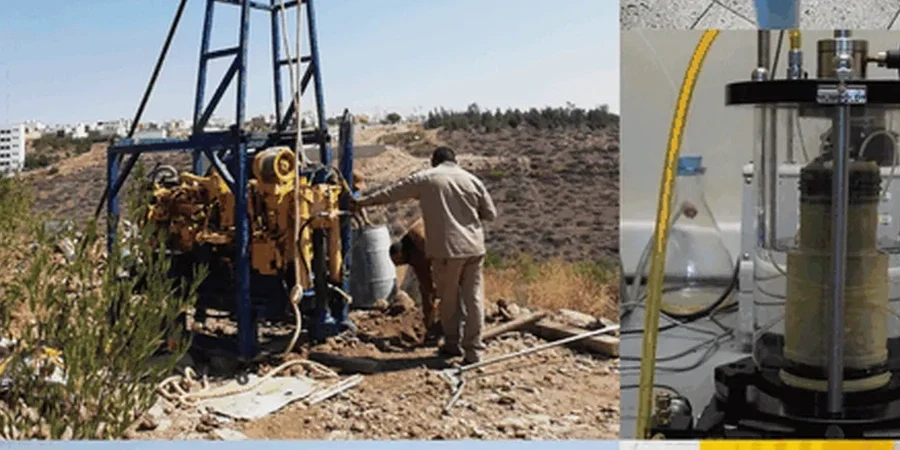
Our soil mechanics study in Vaughan integrates field investigation, advanced laboratory testing, and geotechnical modeling to deliver a complete characterization of the site. Every program is designed to meet Ontario's excess soil regulations and offer actionable parameters for structural engineers.
Advanced Laboratory Testing
Triaxial shear (CU and CD), incremental oedometer consolidation, and chemical analysis for sulfate and chloride content per CSA A23.3 to determine exposure class for underground concrete elements.
In-Situ Stratigraphic Logging
Continuous sampling of the Halton Till, Sunnybrook Drift, and Lower Sediments using hollow-stem auger and thin-walled Shelby tubes to capture the precise transition depths and groundwater regimes.
Foundation Engineering Analysis
Bearing capacity calculations for shallow footings on stiff till, settlement predictions under sustained loads, and lateral earth pressure coefficients for permanent and temporary shoring systems.
Top questions
What is the typical scope and cost of a soil mechanics study in Vaughan?
The scope depends on the proposed structure and site geology. For a standard residential or mid-rise commercial lot requiring one deep borehole, select Shelby tube samples, and a suite of classification and shear strength tests, the fee ranges from CA$4.420 to CA$6.280. This includes the factual report, lab data sheets, and geotechnical recommendations.
How deep do you need to drill to reach competent bearing strata in Vaughan?
It varies significantly by location. In the core of the city near Highway 7, the stiff to hard Halton Till is typically encountered at depths of 3 to 6 meters. However, in the northern reaches near the King-Vaughan border, the till can be much deeper, buried under thick sequences of sand and gravel outwash, requiring boreholes extending 12 to 15 meters.
Does the study address the risk of sulfate attack on concrete?
Absolutely. The Halton Till and underlying shale bedrock can contain significant gypsum and sulfide minerals. We test soil and groundwater samples for sulfate concentration and pH, and specify the appropriate CSA A23.3 exposure class (S-1, S-2, or S-3) to ensure the structural engineer selects sulfate-resistant cement and adequate cover.
Can the soil mechanics study help with excess soil management planning?
Yes. Since Ontario Regulation 406/19 came into effect, characterizing excavated material is mandatory. Our analysis includes leachate testing and chemical characterization to classify the soil for reuse or disposal, helping you avoid costly delays and compliance penalties during construction.
What is the difference between drained and undrained parameters for my Vaughan site?
In Vaughan's low-permeability clay tills, undrained conditions (high pore pressure) govern during rapid loading, like an excavation or a sudden storm. Drained parameters apply to long-term settlement. We run CU triaxial tests with pore pressure measurement to offer both sets of parameters so your design remains safe during construction and over the building's lifespan.