Vaughan’s rapid transformation from agricultural township to a major urban centre north of Toronto brings a unique set of geotechnical challenges that directly influence shallow foundation design. The city sits atop a complex glacial legacy — the Oak Ridges Moraine to the north and the South Slope till plains to the south — creating a patchwork of dense silty clay tills, sand lenses, and occasional soft organic deposits near the Humber River floodplain. When a site investigation skips proper characterization of these units, foundation performance suffers. In our work across Woodbridge, Maple, and Thornhill, we have seen how a standard footing design that works perfectly in one postal code fails dramatically three blocks away because the underlying till transitions to a stiffer matrix. This geological variability makes it essential to combine in-situ permeability testing with laboratory classification, especially where perched groundwater tables appear during spring thaw. The Ontario Building Code (OBC), referencing NBCC 2020, demands a serviceability limit state assessment that accounts for total and differential settlement — a calculation that is meaningless without accurate stratigraphy from a qualified geotechnical provider.
A foundation designed without understanding Vaughan's glacial stratigraphy is just a concrete slab waiting to crack — the soil tells the story before the building does.
Service characteristics in Vaughan
Live process video
Local geotechnical conditions in Vaughan
The most persistent error we observe in Vaughan’s residential and light commercial sector is the assumption that a single borehole log from one corner of the lot is representative of the entire building footprint. Many smaller projects proceed with footing widths based on a presumed bearing capacity of 150 kPa, only to encounter a pocket of saturated sandy silt — or worse, a buried organics-filled gully — during excavation. The cost of halting construction, importing granular fill, and redesigning the footing geometry far exceeds the investment in a proper exploration program. A second, equally dangerous shortcut is neglecting the effect of mature deciduous trees common in older neighbourhoods like Thornhill Woods. The root systems of large maples and oaks can desiccate the underlying clay to depths exceeding 3 metres during summer drought, causing shrinkage that pulls the soil away from the footing underside. The resulting settlement pattern is notoriously difficult to predict without a atterberg limits analysis to quantify the soil’s shrink-swell potential. When these risks materialize, the foundation repair involves costly underpinning that disrupts occupancy and can delay project closeout by months.
Our services
Our shallow foundation design work in Vaughan is structured around two core service modules that cover the full project lifecycle — from initial feasibility to construction-phase verification. Both are delivered under the supervision of a Professional Engineer licensed in Ontario.
Geotechnical Investigation & Foundation Recommendation Report
This package includes borehole drilling, split-spoon sampling, laboratory index testing, and a comprehensive report specifying allowable bearing pressures, anticipated settlements, and footing embedment depths. We correlate all field data with the OBC and NBCC requirements and offer clear, constructible recommendations for spread footings, strip footings, or mat foundations depending on the soil profile encountered. The report also addresses seismic site classification per NBCC Table 4.1.8.4.A, which in Vaughan typically falls into Site Class C or D.
Construction-Phase Verification & Footing Inspection
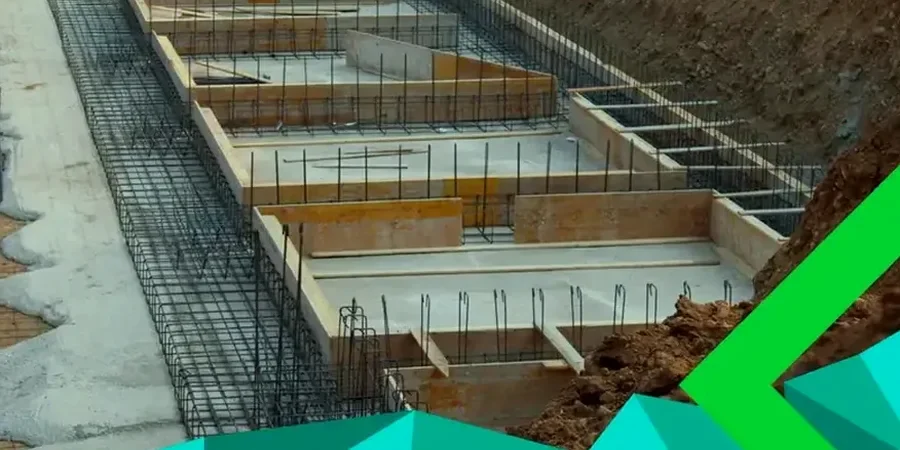
Once excavation reaches the design subgrade elevation, our engineers visit the site to confirm that the exposed soils match the assumptions in the geotechnical report. We perform hand penetrometer tests, visual classification, and, where specified, a plate load test to validate bearing capacity before the reinforcing steel is placed. This verification step is a critical quality assurance checkpoint that protects both the structural engineer and the contractor from liability arising from unforeseen ground conditions.
Top questions
What is the typical cost range for a shallow foundation design package in Vaughan for a single-family home?
For a standard single-detached home in Vaughan, our complete package — including borehole drilling, laboratory testing, and the sealed geotechnical report with footing recommendations — typically falls between CA$2,560 and CA$3,800. The exact figure depends on the number of boreholes required, access constraints on the lot, and whether supplementary testing such as a plate load test is specified. We offer a fixed-fee proposal after reviewing the site address and architectural plans.
How deep do footings need to be in Vaughan to comply with Ontario Building Code frost protection requirements?
The OBC mandates a minimum footing embedment depth of 1.2 metres below finished grade for heated structures in Vaughan, which corresponds to the regional frost penetration depth. For unheated structures or those with perimeter insulation, this depth may be adjusted based on a thermal analysis. We always confirm the final embedment depth in the geotechnical report, as deeper placement may be required in areas with soft or organic surface soils.
What soil types in Vaughan are most problematic for shallow foundations?
The two most challenging soil types we encounter in Vaughan are glaciolacustrine silts and soft organic clays associated with buried stream channels. The silts, deposited by glacial Lake Peel, are prone to sudden settlement when saturated and can lose strength under dynamic loading. Organic deposits, often found in the floodplains of the Humber and Don River tributaries, are highly compressible and must be either excavated and replaced or bridged with a structurally designed mat foundation. Both conditions require careful identification during the site investigation phase.
How long does a typical shallow foundation design project take from start to finish?
From the initial site investigation to the delivery of the final sealed report, most Vaughan projects are completed within 10 to 14 business days. The field drilling component typically occupies one day, laboratory testing requires five to seven working days, and report preparation and professional review take an additional three to four days. We can accommodate faster turnaround when project schedules demand it, provided we have early access to the site and architectural foundation plans.
Can you design a shallow foundation on fill material in Vaughan?
It depends entirely on the nature, thickness, and placement history of the fill. Uncontrolled fill — common on older Vaughan properties that were levelled decades ago without compaction records — is generally not suitable for direct support of spread footings. In these cases, we either specify a deepened foundation that extends through the fill into competent native soil, or we design a mat foundation that can tolerate some degree of settlement. If the fill is thin and of known engineered origin, we may be able to qualify it for support after verifying its density with field testing and correlating the results with our laboratory data.