Vaughan's rapid transformation from agricultural township to major urban center north of Toronto brought unique geotechnical challenges. The city sits atop complex glacial deposits—Halton Till overlying Georgian Bay shale—creating layered soil profiles that demand precision anchoring. With the extension of Line 1 subway to Vaughan Metropolitan Centre, deep excavation projects multiplied. We see the same soil variability from Woodbridge to Maple. A proper anchor design here isn't a template job. It requires understanding how stiff clay interbedded with sand lenses behaves under load. Many firms overlook the perched water tables common across Vaughan's moraine landscape. Our team integrates grain-size analysis to calibrate bond length in mixed soils, and in-situ permeability testing when groundwater affects grout injection. This data-driven approach avoids the costly surprises that plague generic designs.
A single failed tieback in Vaughan's compressible clay can delay a project three weeks and cost six figures in remediation.
Service characteristics in Vaughan
Local geotechnical conditions in Vaughan
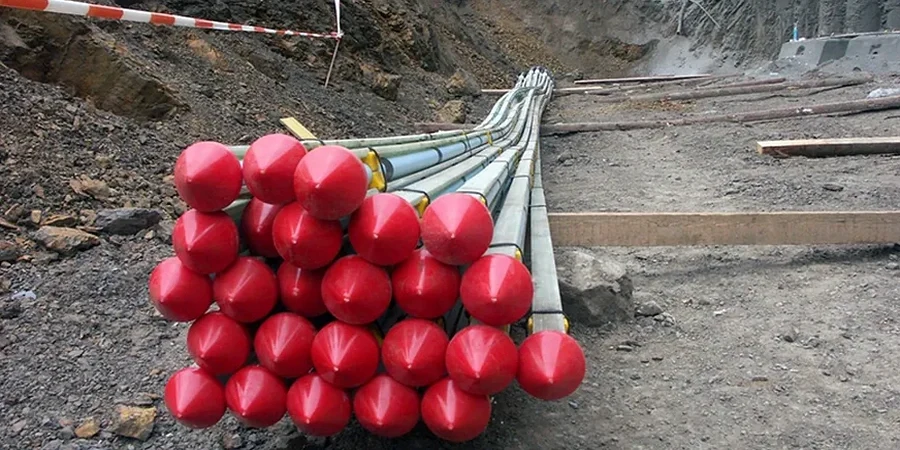
The soil contrast between east and west Vaughan is stark. Near Kipling Avenue, you hit shale bedrock within 8 meters—ideal for short, high-capacity anchors. Move west to the Humber River valley, and you're dealing with 20 meters of compressible clay with organic layers. That's where passive anchors become problematic. Creep rates in these soft clays can exceed 2 mm per month under sustained load. We've seen lock-off loads drop 15% within three weeks on poorly designed anchors in the Woodbridge area. The risk isn't theoretical. A 2019 excavation failure near Highway 7 resulted from bond zone placement within a silt seam that wasn't identified during investigation. For these conditions, we specify regroutable anchors or switch to active systems with load cells for long-term monitoring. Shale interfaces pose a different risk—drill deviation can place the bond zone partially in weathered rock, reducing capacity by 40%. We mandate downhole surveys for any anchor exceeding 15 meters in mixed ground.
Our services
Our anchor design package covers the full lifecycle of your shoring system, from feasibility to lock-off. Every project includes stamped calculations and field-testing protocols.
Tieback Design & Analysis
Full active/passive anchor design with bond length optimization, free length calculation, and load distribution analysis. Includes finite element modeling for grouped anchors.
Proof Testing & Verification
On-site supervision of performance tests, creep tests, and proof tests per CSA A23.3. Load-displacement curves analyzed in real time with automatic pass/fail criteria.
Long-Term Monitoring Systems
Load cell installation, data logging, and remote monitoring for permanent anchors. Automated alerts if lock-off load drifts beyond 5% threshold.
Top questions
What’s the difference between active and passive anchors?
Active anchors are stressed and locked off against the wall after installation—they apply a pre-compression to the soil mass. Passive anchors only develop resistance when the wall moves and loads the tendon. In Vaughan, we use active anchors for most permanent shoring walls because they limit initial deformation. Passive anchors work for temporary cuts in stiff till where some movement is acceptable.
How much does anchor design cost for a typical Vaughan project?
Design fees range from CA$1,400 for a straightforward temporary shoring scheme with 10–20 anchors to CA$5,500 for a permanent wall requiring corrosion protection, seismic analysis, and monitoring specifications. Complex sites with variable soil profiles or adjacent heritage structures fall at the higher end.
How deep can you install anchors in Vaughan’s glacial till?
We routinely design anchors with bond zones between 6 and 12 meters depth in till, with total lengths reaching 25 meters. Depth depends on excavation geometry and the location of the failure plane. We verify bond stress assumptions with on-site pull-out tests before finalizing tendon lengths.
Do I need a building permit for anchored shoring in Vaughan?
Yes. The City of Vaughan requires a shoring permit for excavations deeper than 3 meters or within 6 meters of property lines. Our submission package includes signed and sealed design drawings, a geotechnical baseline report, and a construction monitoring plan—all compliant with the Ontario Building Code and city by-laws.